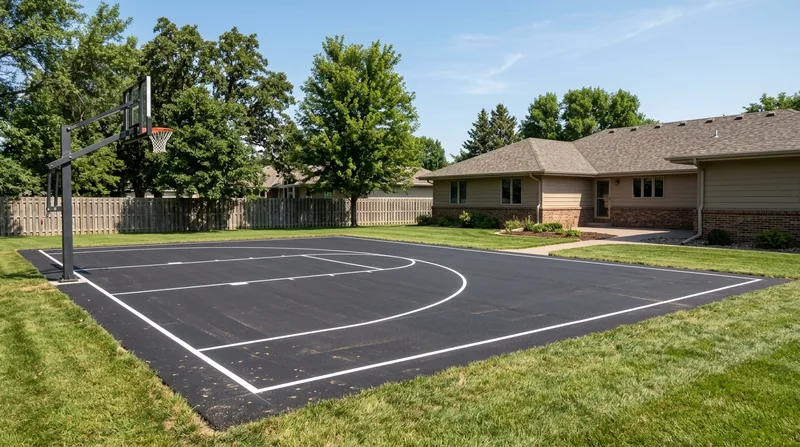




Sports Court & Path Paving in Sioux Falls demands a foundation engineered for the region's unforgiving freeze-thaw cycle and dense glacial clay that sits over ancient quartzite bedrock. Backyard tennis courts, basketball courts, and recreational paths see the worst of Sioux Falls winters, where the 42-inch frost depth heaves an inadequate base and spring thaw cracks asphalt that was not laid over proper compacted stone and grading. We grade and compact a stable base, then finish with hot mix asphalt so the court plays flat through freeze-thaw and hail, season after season. Unlike a driveway that takes occasional traffic, a court surface must hold its plane under repeated foot traffic and the lateral stresses of sport. The difference between a court that cracks in its second winter and one that lasts a decade is the base work we do before the asphalt ever goes down.
Why Court and Path Paving Matters in Sioux Falls: Frost Heave and the Clay Problem
Sioux Falls sits on dense, slow-draining glacial till and clay loam that expands when frozen. A court or path without proper base preparation will heave unevenly as water in the clay freezes, then settle unevenly as it thaws in spring. This cycle breaks asphalt from underneath, creating the alligator cracking and settlement that ruins a playing surface in just a few seasons. The region's blizzards, wind, and hail add their own damage on top of that freeze-thaw stress. A properly graded and compacted base with adequate stone depth resists that heave and keeps the court level through the winter.
- We excavate to competent soil and establish proper drainage so water does not pool under the court.
- We lay and compact a stone base deep enough to resist frost penetration and distribute loads evenly.
- We finish with hot mix asphalt in two courses, binder and surface, so the court stays true under foot traffic and weather.
- We proof roll the base to verify compaction before any asphalt is placed, catching soft spots before they become failures.
This is why a court paved on a shallow base or unprepared ground fails quickly in Sioux Falls, while a properly built court serves for fifteen to twenty years.
Local reality: A homeowner in southwest Sioux Falls near Lake Madison or in the newer subdivisions spreading toward Hartford and Tea will see frost heave especially fast because the soil there is clay loam over quartzite, and the water table can be high. A court built without attention to drainage and base depth will show settlement and cracking by the second spring thaw.
For more information on how we handle challenging soil conditions, see our gravel driveway installation and grading page, where we explain base preparation in detail.
How We Build a Court or Path That Holds: Our Process in Sioux Falls
Court and path paving begins with understanding the site drainage and soil bearing capacity. We visit the location, evaluate the existing grade, check for low spots where water collects, and plan the excavation and base depth. Once we have a clear picture of the soil and drainage, we execute the work in logical steps so the finished court is level, stable, and ready for years of use.
- We mark utilities through South Dakota 811 before any excavation to avoid hitting gas, electric, water, or fiber lines.
- We remove existing pavement and soft soil down to competent bearing material, adjusting depth based on what the soil tells us.
- We grade and slope the subgrade to shed water away from the court area so it does not pond and freeze underneath.
- We lay crushed stone base in lifts, compacting each lift with a vibratory roller until it reaches specified density.
- We place the hot mix asphalt in a binder course, then a surface course, finishing to the specified thickness and slope.
- We proof roll the finished surface with a heavy roller and inspect for any soft spots or areas that need rework before we release the court.
The entire process, from excavation to final compaction, is designed to create a court surface that resists the freeze-thaw damage that dominates asphalt failure in Sioux Falls.
Example: A family in Brandon wanted a half-court basketball area in their backyard. The site had poor drainage and clay loam soil. We excavated 18 inches, laid 12 inches of compacted stone base with proper slope, then finished with 3 inches of hot mix. Two winters later, the court is still flat and has no cracking. Without that base work, settlement and heave would have ruined it by now.
For details on how we manage similar base preparation for other projects, visit our asphalt resurfacing page to see how we evaluate when a surface can be overlaid versus when it needs full-depth work.
Sports Court and Path Paving Methods: What Works in Sioux Falls
| Approach | Description | Best For |
|---|---|---|
| New court construction | Full excavation, base preparation, grading, and placement of binder and surface asphalt courses. | Backyard courts on raw ground, new subdivision lots, or sites with poor existing drainage. |
| Overlay on existing court | Placement of new hot mix asphalt over a structurally sound but worn existing court surface. | Courts with cosmetic cracking or weathering but no base failure, when the base still provides solid support. |
| Full-depth replacement | Complete removal of failed asphalt and base, new excavation and compaction, and new paving from subgrade up. | Courts with extensive alligator cracking, settlement, or base failure from frost heave or poor original construction. |
| Path paving and widening | Asphalt paths from 4 to 8 feet wide, connecting courts to houses or providing walking surfaces through yards. | Recreational paths, access routes to courts, and graded walkways where drainage and base prep are as critical as the court itself. |
Sports Court and Path Paving Cost in Sioux Falls: What to Expect
Court and path paving costs in Sioux Falls start at $8,500 for a small single-court project with good site conditions and straightforward drainage. The final price depends on several concrete factors: the size of the court or path, the depth of excavation required, the complexity of grading and drainage, and whether you are building on virgin ground or replacing a failed court. A site with dense clay soil that requires deeper base preparation will cost more than a site with sandy loam. A court that needs full-depth replacement costs significantly more than an overlay on a sound base.
We recommend getting two or three written estimates from local contractors so you can compare scope, base depth, asphalt thickness, and warranty terms. A low estimate that skips base work or specifies thin asphalt will fail faster and cost more to fix. Our estimates include tonnage specifications and base depth so you can verify that you are getting the work the court needs.
For a detailed pricing overview and to understand what moves costs up or down, see our full pricing page. Call us at (605) 789-2974 for a free, no-obligation estimate on your specific court or path project.
Sports Court and Path Paving Near Me: What to Look for When Hiring a Contractor in Sioux Falls
Hiring the right contractor for a court or path is critical because the work is mostly hidden underground, and you cannot see the base preparation or compaction once the asphalt is down. A contractor who cuts corners on base work will deliver a court that looks good for a year and then fails. Ask any contractor you are considering for a written estimate that specifies base depth, stone type, compaction method, asphalt thickness in each course, and tonnage. Get references from recent court or path projects in the Sioux Falls area and call those homeowners to ask how the court has held up through at least one winter.
Verify that the contractor carries general liability insurance and can provide a certificate of insurance. Check that the contractor has been in business locally for several years, not a traveling crew that appears after a storm with an unsolicited offer and a cash-only deal. Ask about the workmanship warranty on the installation itself, which should be one to three years. Do not trust any contractor who promises a lifetime warranty on the asphalt or the court, because asphalt is a material, not a manufactured product, and no honest contractor can guarantee it will never crack.
If your court or path requires a permit, check with your city or village building department to understand what is required before you hire. Some jurisdictions in Greater Sioux Falls require permits for any impervious surface, while others do not. An HOA may have architectural standards that govern driveway or court materials. We can help you navigate local permitting, but the rules vary from one municipality to the next, so verify with your building department first.
For a free estimate and to discuss your court or path project with a local contractor, contact us online or call (605) 789-2974. We will visit the site, evaluate the soil and drainage, and give you a detailed estimate with no obligation to book.
Sports Court & Path Paving in Sioux Falls: Pricing Guide
| Service | Price | Details |
|---|---|---|
| Small court or path, good site conditions | Starting at $8,500 | Includes base prep, grading, compaction, and 3-inch hot mix asphalt finish on level ground |
| Full-size backyard court with challenging drainage | Starting at $12,000 | Deeper excavation, enhanced base, and slope grading to manage Sioux Falls clay soil and frost heave |
| Overlay on existing sound court surface | Starting at $6,500 | New hot mix placed over existing court base, no excavation, faster timeline than full replacement |
| Full-depth replacement of failed court | On estimate | Complete removal and reconstruction required when base is compromised by frost heave or poor original work |
| Site visit and written estimate | Free | Response within 24 hours, includes base depth, tonnage, and thickness specifications so you can compare bids |
Indicative pricing, the exact cost depends on square footage, finish, and site access. Free personalized estimate within 24h at (605) 789-2974.


